
Five young jobseekers saying hello to Heron.

The cast
Five Go to Heron for Work.
Five anonymized young jobseekers in Nottingham, aged 16-24, came to Blossom through the Restart Scheme with Heron Foods jobs on the map in Bulwell, Bilborough and Meadows.
Julian, George, Dick, Anne and Sarah did not arrive in a tidy little line. They came one by one, each trying to work out something different: availability, fit, confidence and travel.
A job application shows the answer. This story shows their climb towards it.
 Julian
The permission-asker
Julian
The permission-asker
 George
The gatherer
George
The gatherer
 Dick
The first-timer
Dick
The first-timer
 Anne
The aisle-walker
Anne
The aisle-walker
 Sarah
The timetable-checker
Sarah
The timetable-checker
Five different openings
They did not all knock in the same way.
Julian asked permission. George arrived with pieces that needed joining together. Dick named the gap before naming what they could do. Anne moved quickly towards the application. Sarah checked the practical fit: place, hours and pressure.
Permission, pieces, a first chance, urgency and the timetable: five ways of stepping forward, each carrying a different clue about what the young person needed next.
The second door
The questions that opened the second door.
They had already found the first door: the job. Blossom's next questions opened the second: how they might fit.
A customer story. A moment of responsibility. Help given somewhere other than a shop. A busy shift imagined before it happened. A practical answer about pressure and priority. The questions changed with the person; the purpose stayed the same.
Read Julian's page transcript
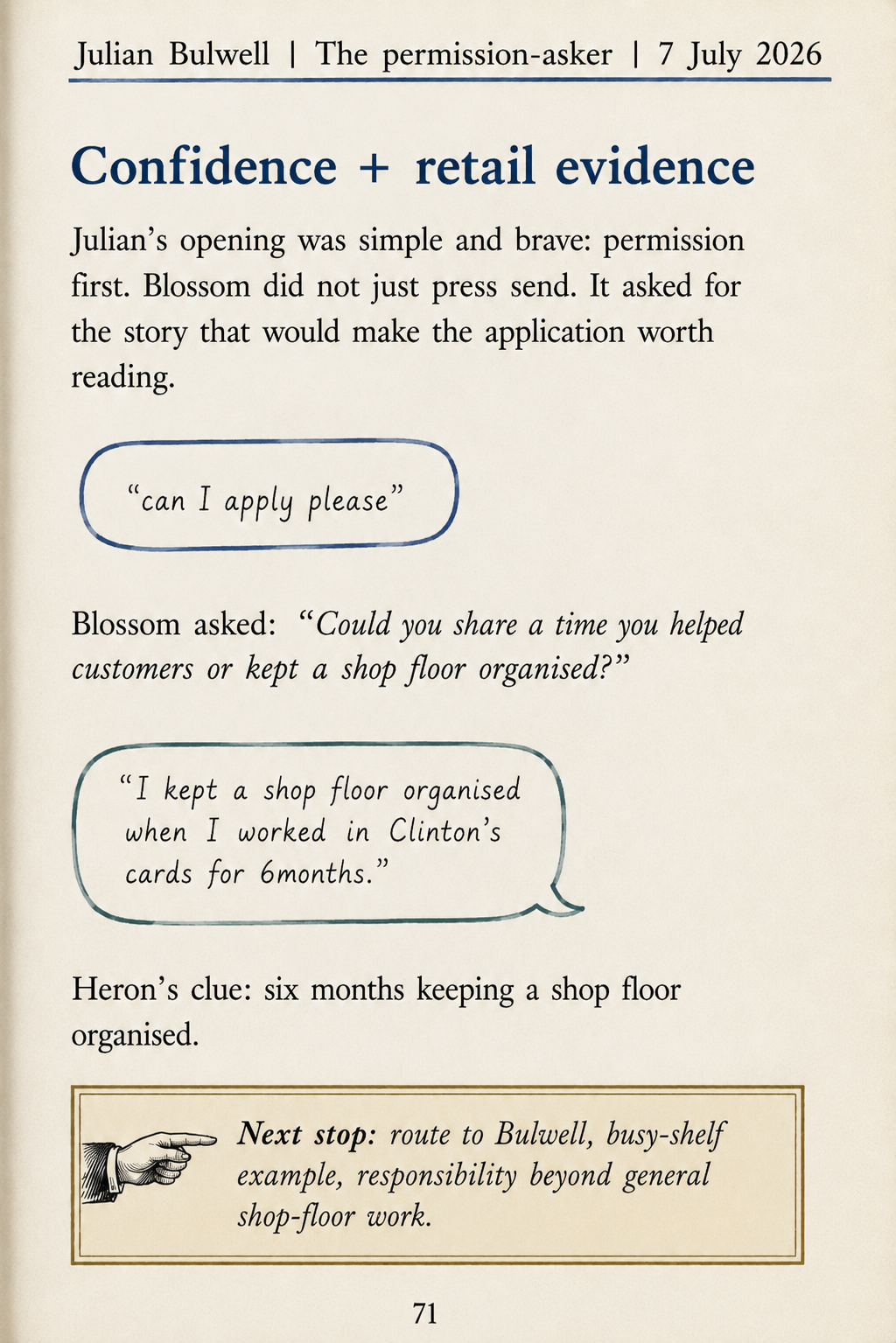
Julian, Bulwell. The permission-asker. Confidence and retail evidence.
Julian's opening was simple and brave: permission first. Blossom did not just press send. It asked for the story that would make the application worth reading.
Opening: "can I apply please"
Blossom asked: "Could you share a time you helped customers or kept a shop floor organised?"
Julian answered: "I kept a shop floor organised when I worked in Clinton's cards for 6months."
Heron's clue: six months keeping a shop floor organised.
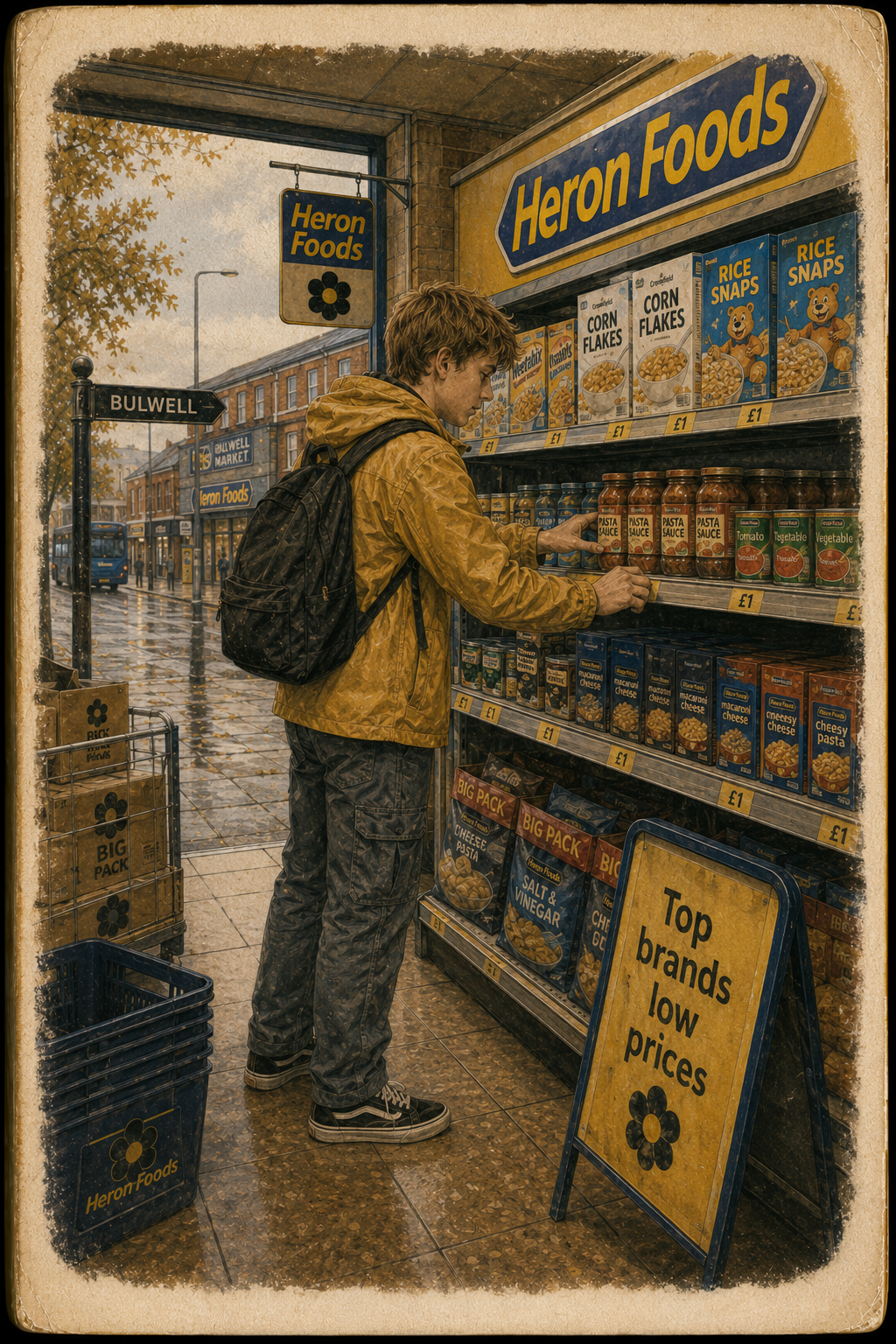
Next stop: route to Bulwell, busy-shelf example, responsibility beyond general shop-floor work.
Read George's page transcript
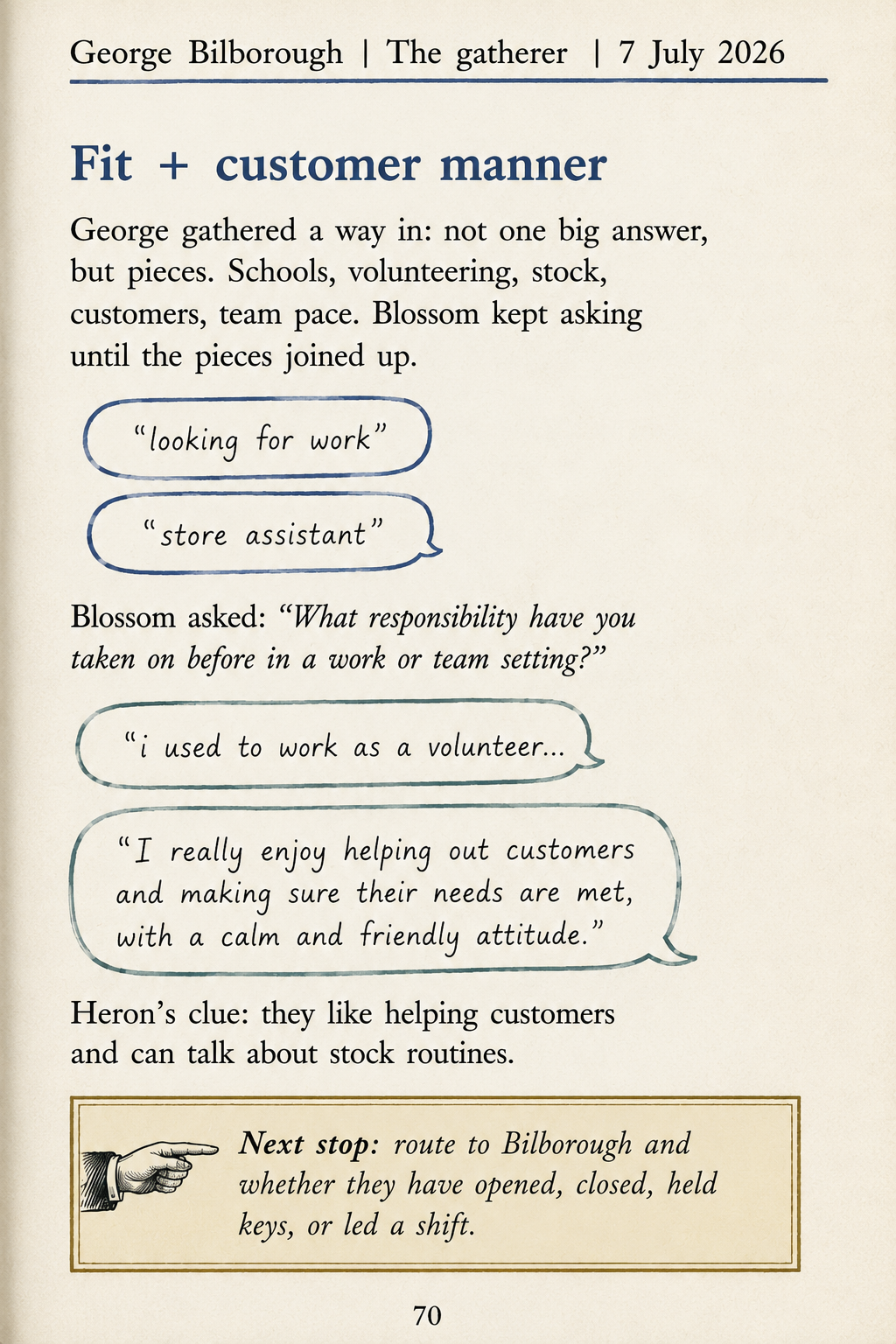
George, Bilborough. The gatherer. Customer service and team fit.
George gathered a way in: not one big answer, but pieces. Schools, volunteering, stock, customers, team pace. Blossom kept asking until the pieces joined up.
Openings: "looking for work" and "store assistant"
Blossom asked: "What responsibility have you taken on before in a work or team setting?"
George answered: "i used to work as a volunteer..." and "I really enjoy helping out customers and making sure their needs are met, with a calm and friendly attitude."
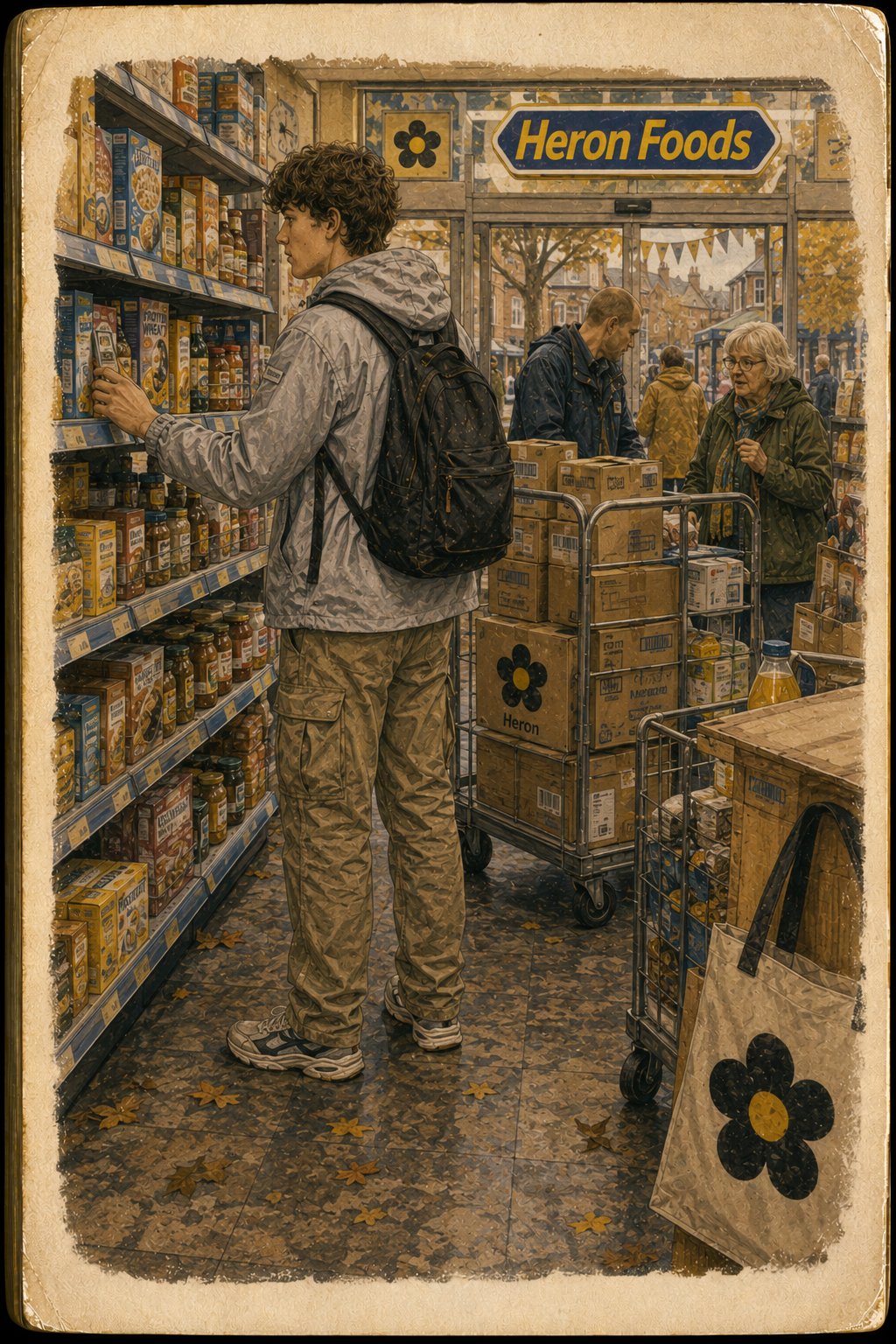
Heron's clue: they like helping customers and can talk about stock routines.
Next stop: route to Bilborough and whether they have opened, closed, held keys, or led a shift.
Read Dick's page transcript
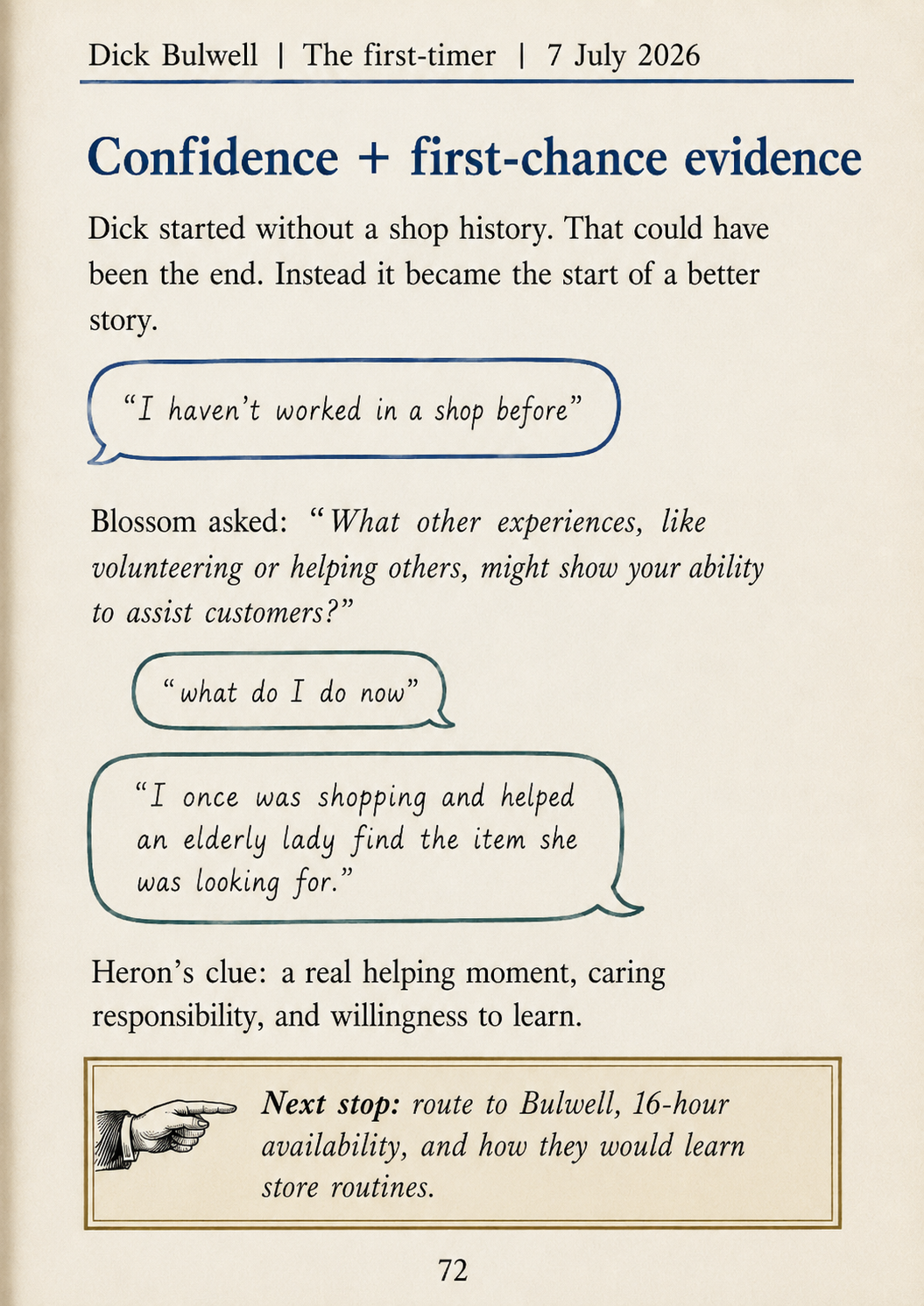
Dick, Bulwell. The first-timer. Confidence and first-chance evidence.
Dick started without a shop history. That could have been the end. Instead it became the start of a better story.
Opening: "I haven't worked in a shop before"
Blossom asked: "What other experiences, like volunteering or helping others, might show your ability to assist customers?"
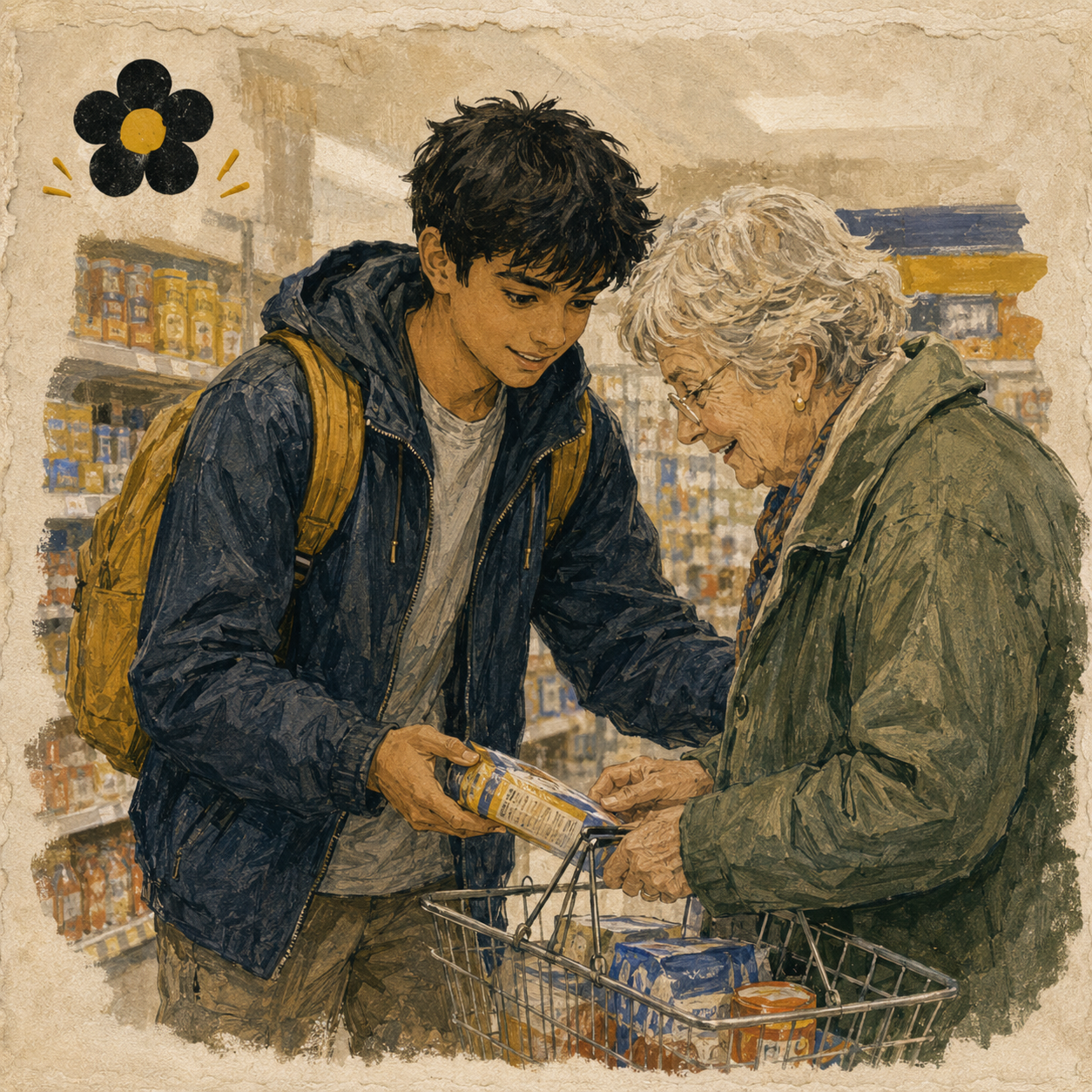
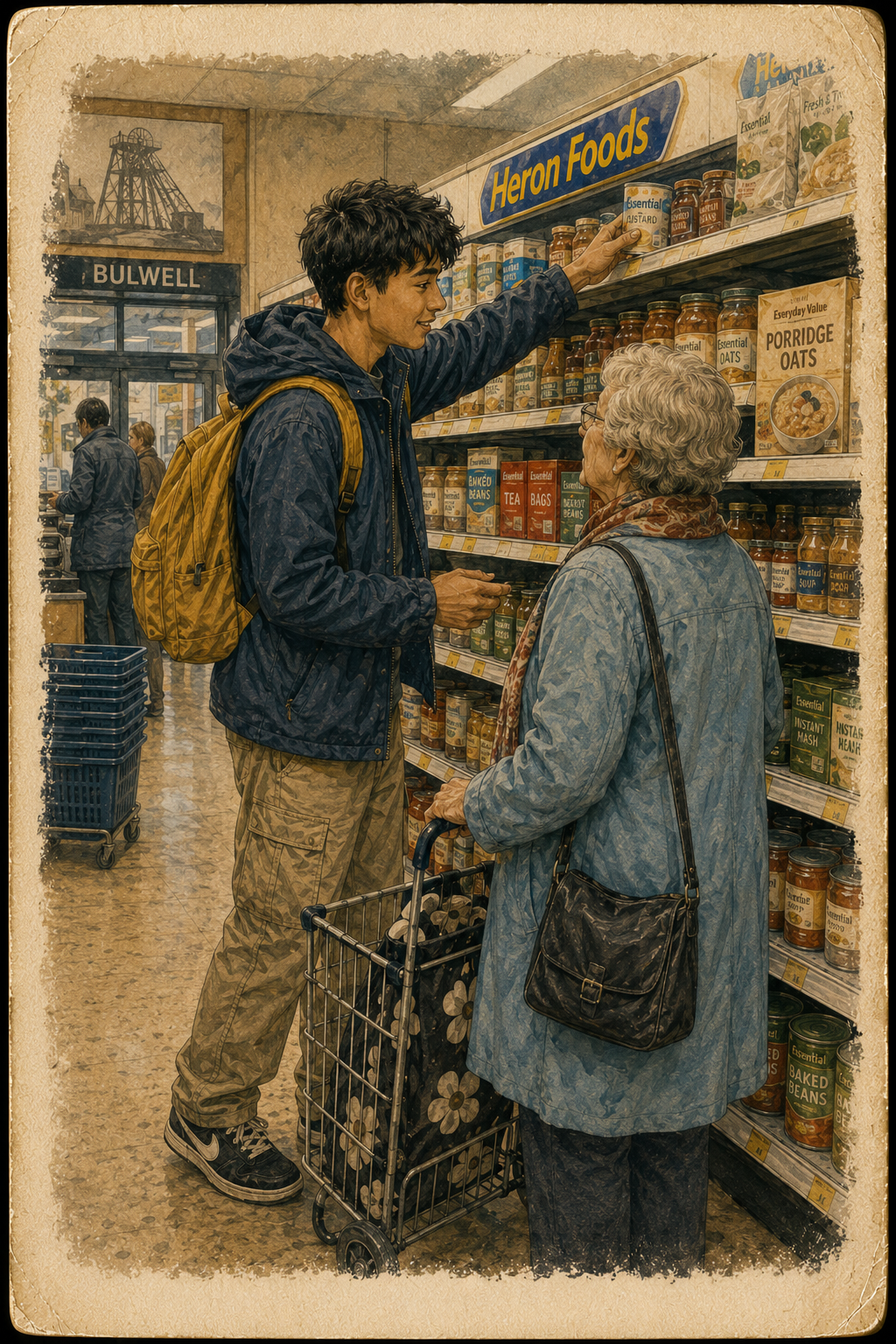
Dick answered: "what do I do now" and "I once was shopping and helped an elderly lady find the item she was looking for."
Heron's clue: a real helping moment, caring responsibility, and willingness to learn.
Next stop: route to Bulwell, 16-hour availability, and how they would learn store routines.
Read Anne's page transcript
Anne, Meadows. The aisle-walker. Availability and responsibility.
Anne wanted the application to move. Blossom paused the rush and asked them to run the shop in their imagination first.
Opening: "can u send the Application"
Blossom asked: "How would you stay steady when deliveries, shelves, and customers all need attention during a busy shift?"
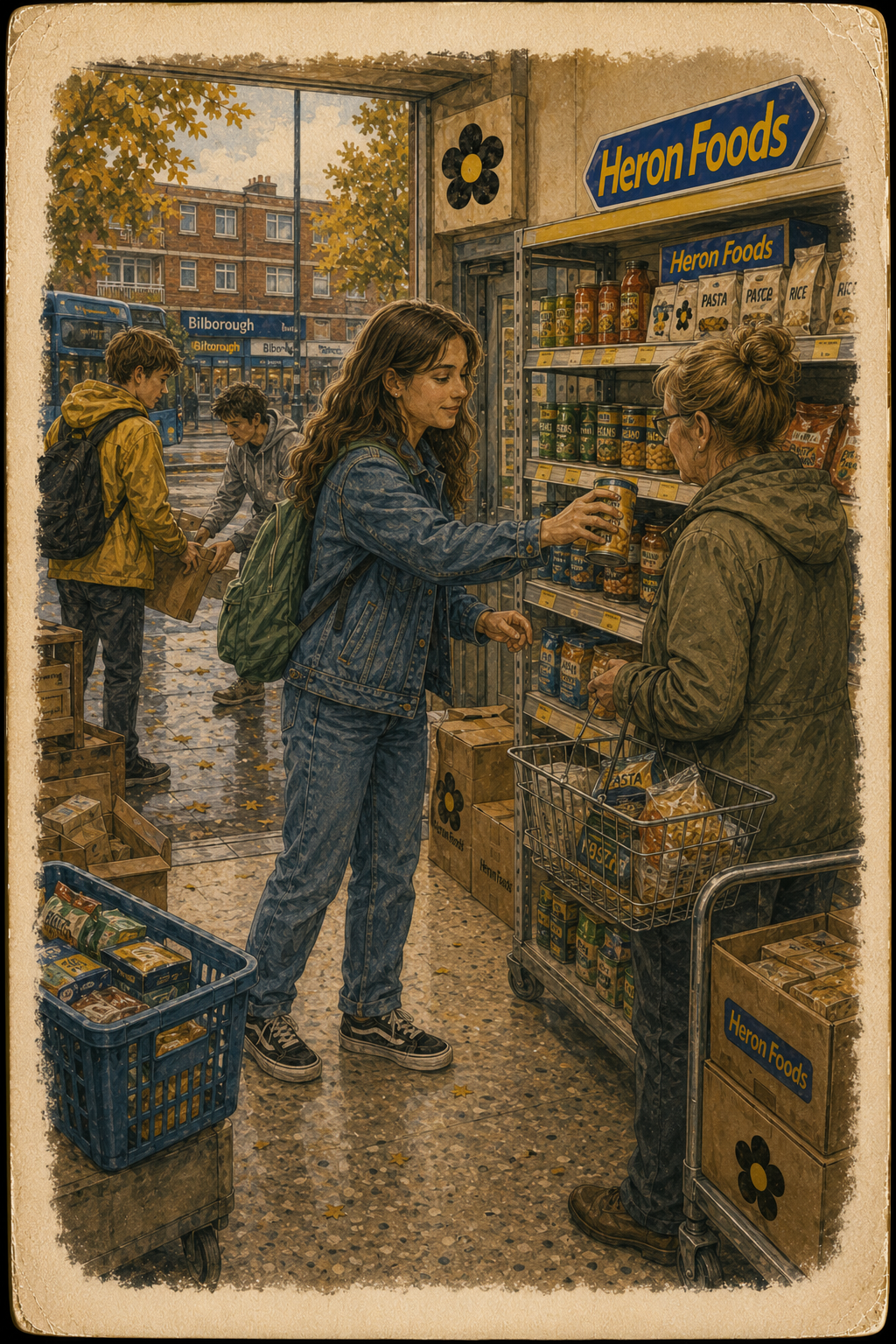
Anne answered: "I would make sure..." and "I was working in a Charity Shop before and the manager left for a few minutes... and asked me to take over."
Heron's clue: they could imagine the shop floor as a set of jobs to keep moving.
Next stop: route to Meadows, exact availability, and the scope of the charity-shop responsibility.
Read Sarah's page transcript
Sarah, Bilborough. The timetable-checker. Travel and hours plus pressure handling.
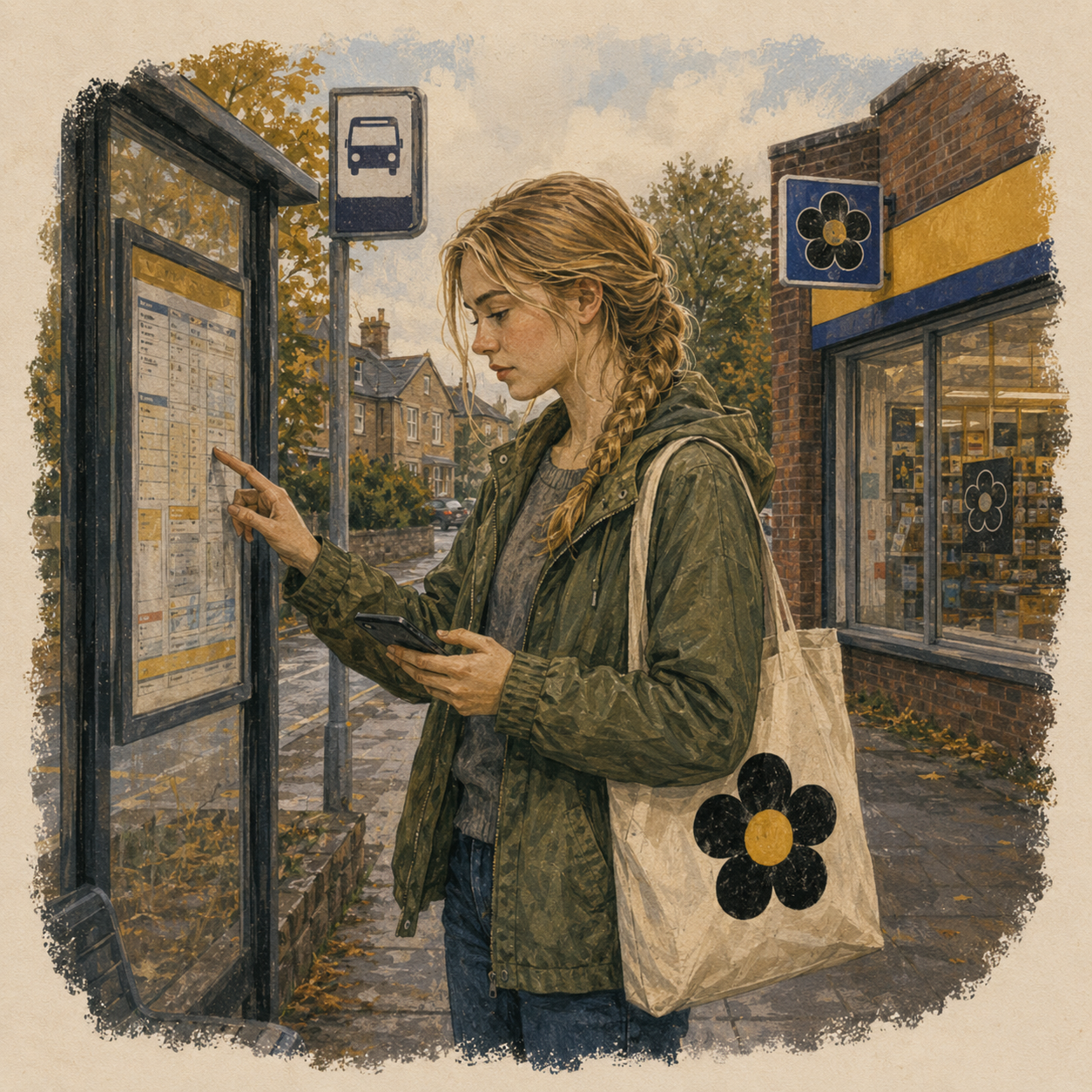
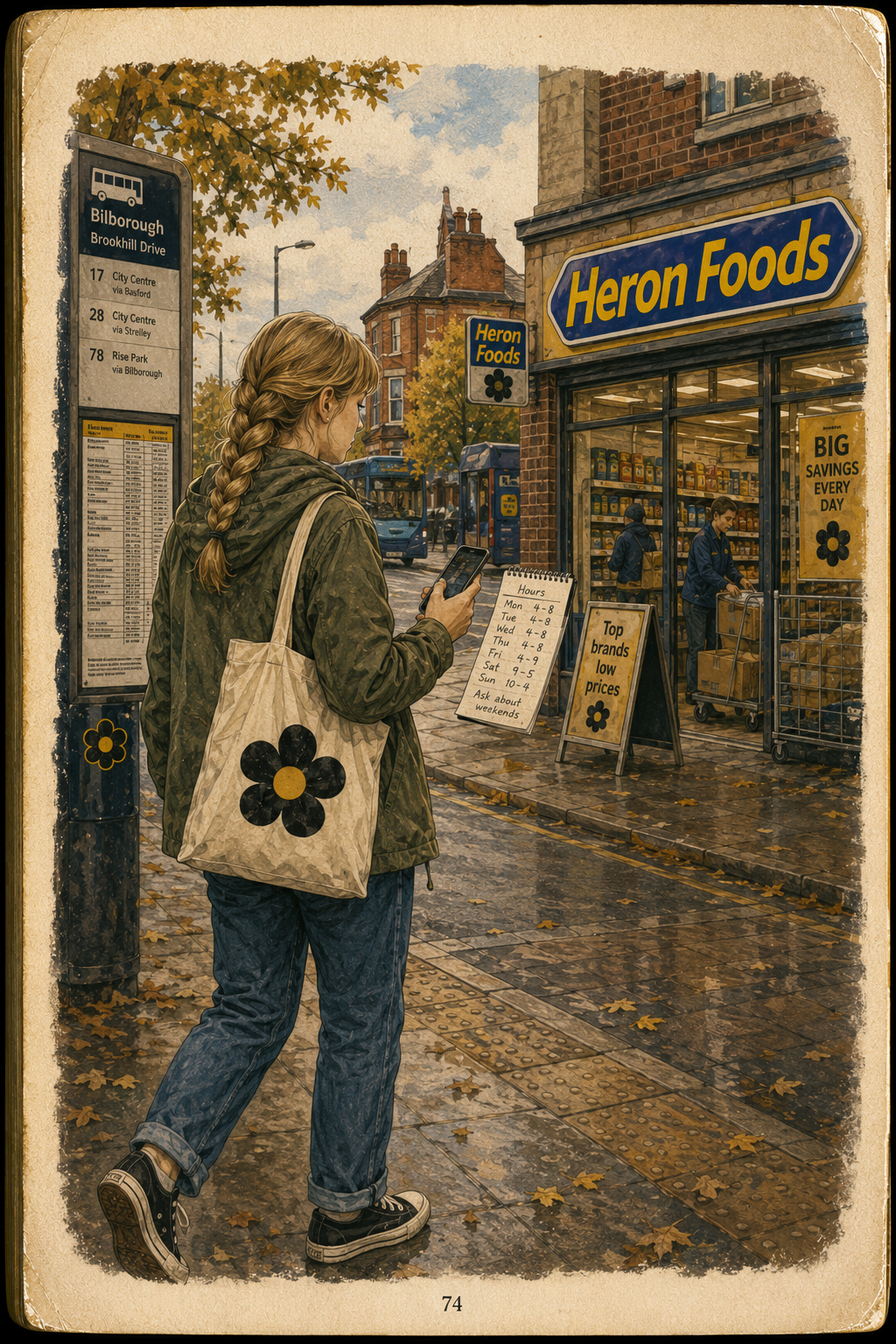
Sarah brought the timetable into the adventure. She wanted part-time sales, then checked the place and the hours. Her approach was practical from the start.
Openings: "looking for work" and "part time sales"
Blossom asked: "How do you stay steady when deliveries, shelves, and customers all need attention during a shift?"
Sarah answered: "I helped people during a time at work experience..." and "I'm able to prioritise urgent customer care and maintain support for my colleagues during a rush."
Heron's clue: prioritising, communicating, helping people, and thinking about working hours.
Next stop: route to Bilborough and whether Monday to Friday is a preference or a hard limit.
What came into view
Blossom’s conversational approach.
Availability
Availability emerged through part-time preferences, working hours and what each person could realistically commit to.
Fit
Fit took shape through customers, shelves, stock, teamwork and responsibility: ordinary evidence translated into the work Heron needs.
Confidence
Confidence did not always arrive first. It grew when a broad question became a clear one and each person had room to answer in their own words.
Travel
Bulwell, Bilborough and Meadows were practical questions, not dots on a map. Store, route and hours all belonged in the same conversation.
All five said "I".
That was the breakthrough. Each person moved from looking at a job to placing themself inside the answer: I helped, I organised, I would, I can. The application records the answer. The conversation reveals the confidence required to say it.
Heron's next chapter
Continue the evidence. Check it. Act on it.
The job requirements allow experience to arrive in different forms. They gave each person room to elaborate on what they had done, providing relevant evidence and the opportunity to reach out with a better understanding of the company, the position and its responsibilities.
The young people have already done the work of finding the job, staying in the conversation and putting experience into words. Heron's task is to check that evidence and act on it, not collect it all again.
Keep the welcome warm. Ask one useful follow-up. Decide who gets the quick call or Pop-In invitation. The adventure has already started; do not send them back to page one.